
Genetics 6 Sections19 LessonsLifetime
Curriculum
- 6 Sections
- 19 Lessons
- Lifetime
Expand all sectionsCollapse all sections
- Introduction2 Items
- Replication1 Item
- Transcription5 Items
- Translation3 Items
- Miscellaneous5 Items
- Gene Expression3 Items
Translation-Synthesis of Proteins
Translation-Synthesis of Proteins
- The process of protein synthesis occurs in 3 stages:
- Initiation
- Elongation, and
- Termination.
Special protein factors for Initiation
- Initiation Factor (IF)
- Elongation (EF) and
- Termination (release factors), as well as
- GTP,
- are required for each stage
Initiation
- In the first step, the small ribosomal subunit binds to the mRNA.
- In Prokaryotes, the 16S rRNA of the small subunit binds to the Shine-Dalgarno sequence in the 5′ untranslated region(UTR) of the mRNA.
- In Eukaryotes, the small subunit binds to the 5′ cap structure and slides down the message to the first AUG.
- The charged initiator tRNA becomes bound to the AUG start codon on the mRNA through base pairing with its anticodon.
- The initiator tRNA in Prokaryotes carries fMet, whereas the initiator tRNA in Eukaryotes carries Met.
- The large subunit binds to the small subunit, forming the completed initiation complex.
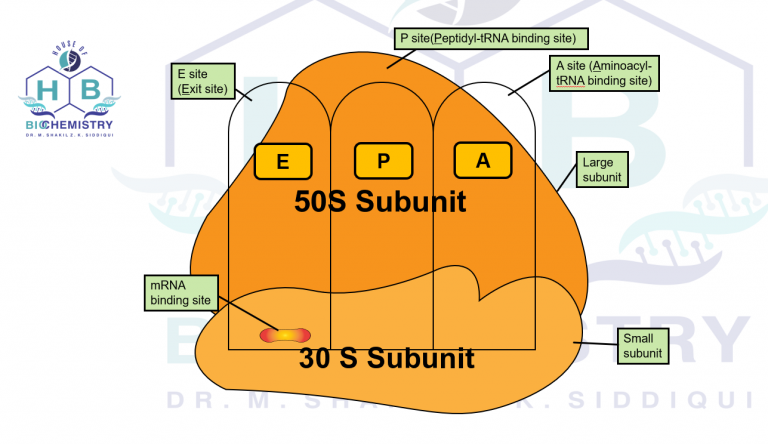
There are 2 important binding sites on the ribosome called the
P site (peptidyl site) & the A site (aminoacyl site)The P site is the site on the ribosome where fMet–tRNAi initially binds.
After formation of the first peptide bond, the P site is a binding site for the growing peptide chain.
The A site binds each new incoming tRNA molecule carrying an activated amino acid.
Elongation
- Elongation is a 3-step cycle that is repeated for each amino acid added to the protein after the initiator Methionine.
- Each cycle uses 4 high-energy bonds (2 from the ATP used in amino acid activation to charge the tRNA, and 2 from GTP).
- During elongation, the ribosome moves in the 5′ to 3′ direction along the mRNA, synthesizing the protein from amino to carboxyl terminus.
Step 1
- A charged tRNA comes and binds in the A site.
- The particular aminoacyl–tRNA is determined by the mRNA codon aligned with the A site.
Step 2
- Peptidyl transferase, an enzyme that is part of the large subunit, forms the peptide bond between the new amino acid and the carboxyl end of the growing polypeptide chain.
- The bond linking the growing peptide to the tRNA in the P site is broken, and
- The growing peptide attaches to the tRNA located in the A site.
Step 3
- The Translocation: In the translocation step, the ribosome moves exactly 3 nucleotides (one codon) along the message.
- This moves the growing peptidyl– tRNA into the P site and aligns the next codon to be translated with the empty A site.
- In eukaryotic cells, elongation factor-2 (eEF-2) used in translocation is inactivated through ADP-ribosylation by Pseudomonas and Diphtheria toxins.
- Shiga and Shiga-like toxins clip an adenine residue from the 28S rRNA in the 60S subunit stopping protein synthesis in eukaryotic cells.
Termination
- When any of the 3 Stop (termination or nonsense) codons moves into the A site, peptidyl transferase (with the help of release factor) hydrolyzes the completed protein from the final tRNA in the P site.
- The mRNA, ribosome, tRNA, and factors can all be reused for additional protein synthesis.
Sir jo diagram thi translation ki vo nae show ho rhi .!?