
Genetics 6 Sections19 LessonsLifetime
Curriculum
- 6 Sections
- 19 Lessons
- Lifetime
- Introduction2 Items
- Replication1 Item
- Transcription5 Items
- Translation3 Items
- Miscellaneous5 Items
- Gene Expression3 Items
Recombinant DNA
Introduction
Genetic recombination is the exchange of information between two DNA segments. It is a common occurrence within the same species. But,
“When a gene of one species is transferred to another living organism (artificially), it is called Recombinant DNA technology.”
It is commonly known as Genetic engineering.
Applications
1. Quantitative Preparation of Biomolecules
If molecules are isolated from higher organisms, the availability is limited. e.g. to get 1 unit of growth hormone, more than 1000 pituitaries from cadavers are required.
By means of recombinant technology, large scale availability is possible.
2. Risk of Contamination is Eliminated
It is possible to produce a biological substance without any contamination through recombinant DNA technology.
Hepatitis, caused by the hepatitis B virus (HBV), is highly contagious.
A vaccine is prepared from the hepatitis B virus surface proteins which will give protection from infection.
3. Specific Probes for Diagnosis of Diseases
Antenatal diagnosis of genetic diseases e.g. many of the single gene defects (e.g. cystic fibrosis, phenylketonuria, etc.) could be identified by taking cell samples from fetus.
To identify viral particles or bacterial DNA in suspected blood & tissue samples.
To demonstrate virus integration in transformed cells.
To detect activation of oncogenes in cancer.
To pinpoint the location of a gene in a chromosome.
To identify mutations in genes and for pedigree analysis: point mutations, deletions, insertions and,
Rearrangements of DNA could be identified – sickle cell disease is an example of point mutation.
4. Gene Therapy
An important application of recombinant technology is in Gene therapy.
Normal genes can be introduced into the patient so that genetic diseases can be cured.
5. Preparation of Specific Human Gene
Isolation of a specific gene from the human DNA is a laborious process e.g. beta globin gene is about 1.6 kbp length, which represents only 0.00005% of total human genes.
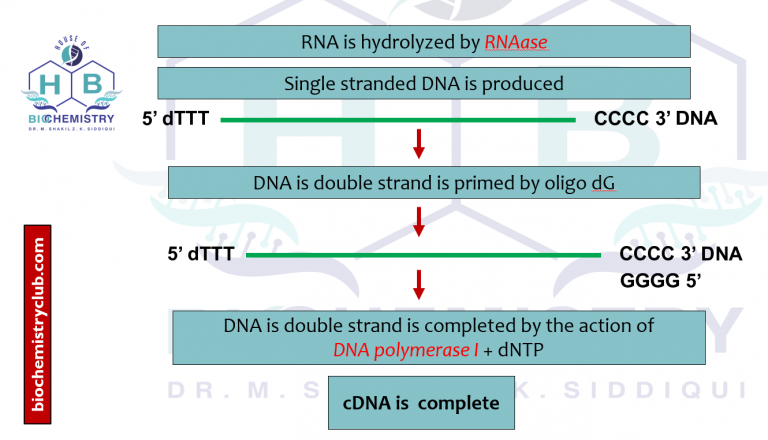
This problem is generally solved by preparation of cDNA (complementary copy DNA).
Procedure
1. Separation of Required Gene
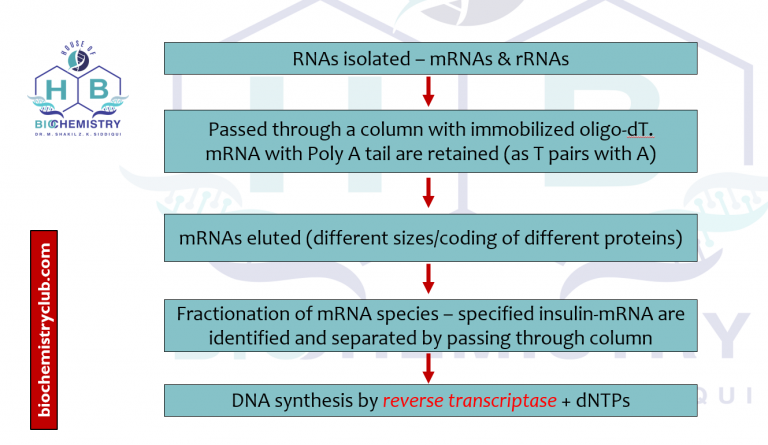
It is easier to start the work with mRNA, because there is selective expression of a particular gene in certain tissue e.g. Insulin, mRNA will be abundant in the beta cells of pancreas.
Another advantage of using the mRNA is that RNA will have only coding sequences (introns are already removed by splicing.
From the specific mRNA, the cDNA is produced by using Reverse transcriptase (rT).

2. Restriction Endonucleases
To transfer a gene, it is first selectively split from the parent DNA.
This is usually done by the use of restriction endonucleases which are referred to as “molecular scissors”.
Restriction endonucleases have specific recognition sites where they cut the DNA.
There are more than 800 such enzymes now available commercially.
These enzymes recognize specific sequence with palindrome arrangement – “to run backwards”.
These are also called inverted repeat sequences, which means the nucleotide sequence in 5′ to 3′ direction is the same in both strands.
The resultant DNA cuts will generally have overlapping or sticky ends.
Restriction endonucleases may also produce blunt ends.
3. Chimeric DNA
A vector carrying a foreign DNA is called Chimeric DNA or Hybrid DNA or Recombinant DNA
A circular plasmid vector DNA is cut with a specific restriction endonuclease (RE).
If EcoRI is used, sticky ends are produced with TTAA sequence on one DNA strand, and AATT sequence on the other strand.
The human DNA is also treated with the same RE.
As a result the same sequences are generated at the sticky ends of the cut piece.
Then the vector DNA & human cut-piece DNA are incubated together so that annealing takes place. The sticky ends of both vector and human DNA have complementary sequences, and therefore they come into contact with each other.
Then DNA ligase enzyme is added, which introduces phosphodiester linkages between the vector and the insert molecules.
The chimeric DNA is finally produced.

4. Homopolymer Tailing
It the property of the sticky ends of the vectors to reconnect themselves without taking up the foreign molecule (recircularization).
To bypass this problem, homopolymer tailing is done in both vector and insert molecules.
First the restriction enzyme, Hpa I is used to produce blunt ends of vector.
Then poly dG is added to the 3′ end of foreign DNA & poly dC is added to the 3′ end of vector DNA.
When the two molecules are incubated, only hybrid varieties are formed as “G” always pairs with “C”.
5. Cloning
“A clone is a large population of identical bacteria or cells that arise from a common ancestor molecule”.
By the help of Cloning we can produce a large number of identical DNA molecules.
The hybrid molecules are amplified by the cloning technique.
6. Transfection
The process by which plasmid is introduced into the host is called Transfection.
Host E. coli cells & plasmid vectors are incubated in hypertonic medium containing calcium for a few minutes.
Then calcium ion channels are opened, through which the plasmid is imbibed into the host cell.
Now the host cells are allowed to grow in agar plates containing
growth medium.
Only 5% of bacterial colonies contain the desired vector. Therefore, we have to select the desired colonies.
7. Insertional Inactivation of Antibiotic Resistant Genes
Plasmid pBR-325 vector contains Apr (ampicillin resistance), Tcr (tetracycline resistance) & Cmr (chloramphenicol resistance) genes.
The restriction enzyme EcoRI cleaves the plasmid in the middle of Cmr gene.
Now all plasmids have only two antibiotic resistance genes, one is inactivated by insertion.
When the foreign DNA is inserted, the resistance against chloramphenicol is lost.
This Insertional inactivation of Cmr gene is the marker for hybrid DNA.
8. Selection of Colony having the Desired Gene
After the transfection, the bacteria are cultured in a medium containing ampicillin and tetracycline.
The antibiotics kill all the wild bacteria. Only the bacteria containing the plasmids will grow.
There will be many colonies, where the vector does not carry the foreign DNA. These colonies are replica-plated onto another agar plate containing chloramphenicol.
Since the insertion of foreign DNA abolishes chloramphenicol resistance, the desired colonies will not grow in the replica-plate.
Colonies in the original plate, corresponding to the dead colonies in the replica-plate are selected as they carry the foreign gene.
These colonies are selected and further subcloned.
Other Technique
Another technique of selecting colonies having plasmids with DNA insert is blue white screen.
Here the plasmids have lac Z gene which is inactivated by insertion of target DNA.
So, the blue product produced by the action of the beta galactosidase is not formed.
Instead the colonies will appear white since the gene is interrupted by the DNA insert.
9. Expression Vectors
To produce the human proteins, E. coli carrying the vector with the insert is allowed to grow, without any protein inhibitors.
Such a vector carrying the foreign gene, which is translated into a protein, is called Expression vector.
The human proteins can be harvested from the bacterial culture.
Proteins Synthesized by rDNA Technology
- Recombinant human insulin.
- Recombinant human growth hormone (hGH, somatotropin) & others (e.g. FHS).
- Recombinant blood clotting factors Factor VIII, Factor IX, (others like tPA, hirudin).
- Recombinant hepatitis B vaccine, HPV vaccine etc.
- Cytokines and growth factors (interferon, interleukins etc.).
- Monoclonal antibodies and other related products(rituximab, trastuzumab etc.).
- Recombinant enzymes (acid A-glucosidase-myozyme, a L-iduronidase – aldurazyme).
- Recombinant HIV protein for HIV ELISA testing.
- Herbicide and insect resistant crops.
- Other products: Bone morphogenic protein (BMP), albumin, fibrinolytic & thrombolytic agents etc.