Genetics 6 Sections19 LessonsLifetime
Curriculum
- 6 Sections
- 19 Lessons
- Lifetime
Expand all sectionsCollapse all sections
- Introduction2 Items
- Replication1 Item
- Transcription5 Items
- Translation3 Items
- Miscellaneous5 Items
- Gene Expression3 Items
PCR-Polymerase Chain Reaction
Polymerase Chain Reaction-PCR
Introduction
- It is an in-vitro DNA amplification procedure in which millions of copies of a particular sequence of DNA can be produced within a few hours.
- It is like Xerox machine for gene copying.
- The flanking sequences of the gene of interest should be known.
- Two DNA primers of about 20–30 nucleotides with complementary sequence of the flanking region can be synthesized.
- Karry Mullis – 1989, awarded Nobel prize in 1993.
Steps inolved in PCR
The reaction involves many steps:
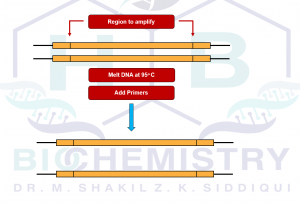
Step 1: Separation (Denaturation)
- The DNA strands are separated (melted) by heating for 15 sec. – 2 min. at 95°C.
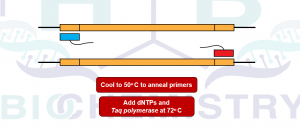
Step 2: Priming (Annealing)
- The primers are annealed by cooling to 50°C for 0.5 to 2 minutes.
- The primers hybridize with their complementary single stranded DNA produced in the first step.
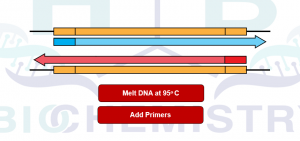
Step 3: Polymerization
- The polymerase reaction is allowed to take place at 72°C for 30 seconds in presence of dNTPs (all four).
- Both strands of DNA are now duplicated.
- This is achieved by the use of Taq Polymerase.
Taq Polymerase
- This enzyme is derived from bacteria Thermus acquaticus that are found in hot springs
- All the enzymes are protein in nature and they are easily denatured at high temperature.
- The enzyme is not denatured at high temperature so it is very useful in this step.
Step 4
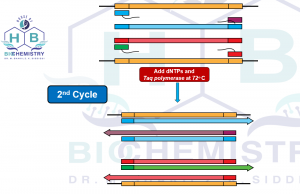
- The steps of 1, 2 and 3 are repeated.
- In each cycle, the DNA strands are doubled.
- Thus 20 cycles provide for 1 million times amplifications.
- These cycles are generally repeated by automated instrument, called Thermal cycler.
Step 5: Hybridization
- After the amplification procedure, DNA hybridization technique or Southern blot analysis with a suitable probe is done.
- This shows the presence of the DNA in the sample tissue.
New Technique
- According to new modifications in technology, all the three cycles of PCR are performed at 63°C for 60 minutes.
- The melting of DNA is achieved, not by high temperature, but by enzymes.
- This reduces the cost of the test.
- The result will be available within a few hours.
Clinical Applications of PCR
- To help in the diagnosis of disease.
- In Medicolegal cases.
- Diagnosis of genetic disorders.
- Prenatal diagnosis of inherited diseases.
- Cancer detection.
- Fossil studies.

👍🏻👍🏻
👍👍👍
❤️