
Genetics 6 Sections19 LessonsLifetime
DNA Repair
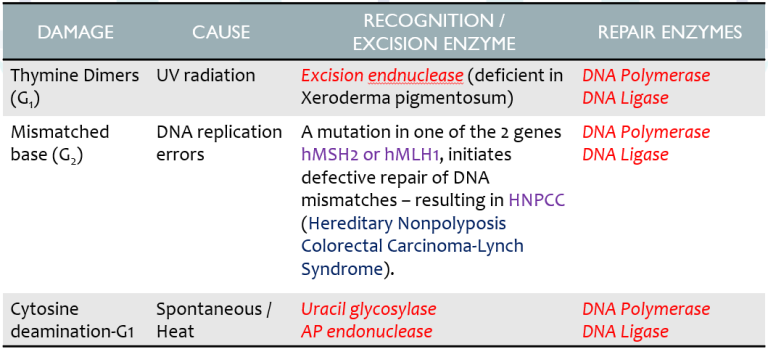

There are 3 major types of DNA mutations:
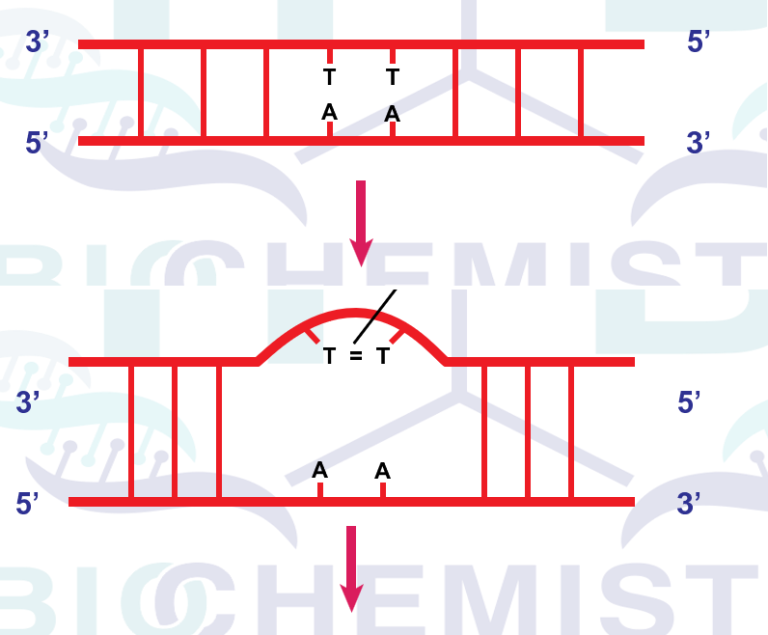
There are Thymine bases that are adjacent to each other.
Due to ultra-violet radiation sometimes two Thymine bases form a dimer with each other by forming a covalent bond.
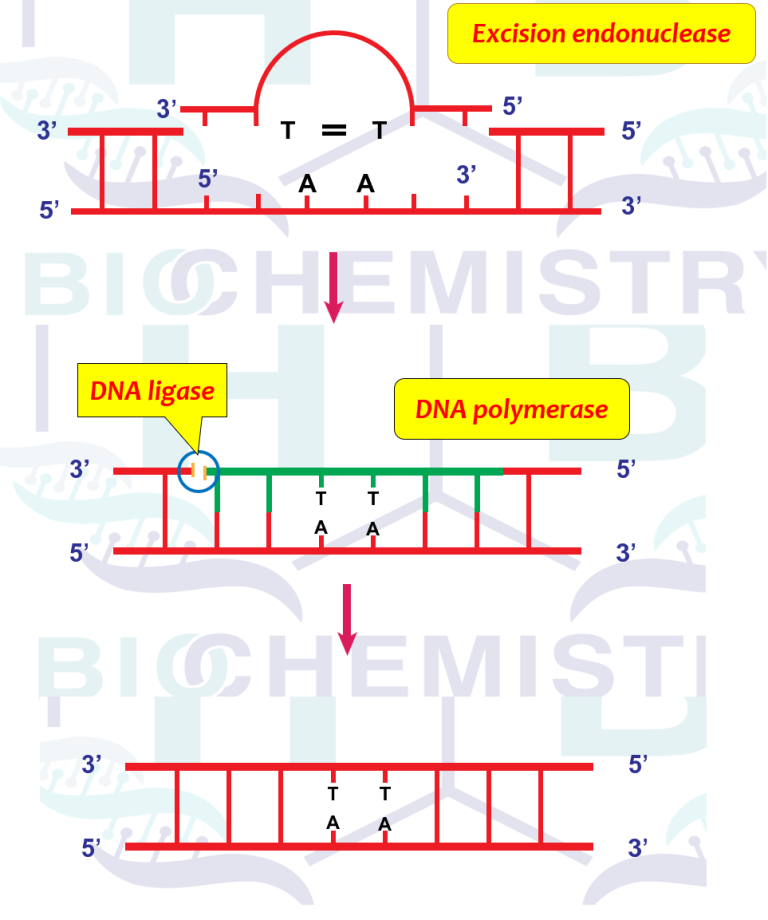
There is an enzyme that is called Excision endonuclease.
This enzyme recognizes the lesion and excises the Thymine dimer that is formed due to UV light.
Other pyrimidines can also form dimers like cytosine-cytosine dimer and uracil-uracil dimer. But they are not clinically relevant.
The excised part is then replaced by DNA polymerase.
DNA ligase then comes in to repair the remaining part.
This disease occurs when an individual inherits a defective copy of the enzyme Excision endonuclease.
This is a autosomal recessive disease that means that the individual must have copies of mutant genes from both parents.
Patient will have the following symptoms:
Mismatch repair occurs in the G2 phase.
There are 2 genes responsible, hMSH2 and hMLH1.
These genes make sure if there is any mismatches in DNA, they are repaired.
But if any one of them is missing then there is no repair and this may cause the disease known as HNPCC (Hereditary Non-Polyposis Colorectal Carcinoma), also known as Lynch Syndrome.
Cytosine Deamination occurs in G1 phase.
In this the cytosine deamination occurs and cytosine is converted to uracil.
If the enzymes Uracil glycolase and AP endonuclease are absent, then as a result Uracil is formed and it accumulates.
Thymine Dimers and Cytosine Deamination occurs in G1 phase.
There are additional genes that control entry into the S phase if there is some mutation.
These genes are Rb (Retinoblastoma) and p53 genes.
These genes delay the entry or the accumulated errors to enter into the S phase.
Because if the mutations enter the S phase, all of them will be duplicated and passed on to each cell.
This gives some time to repair the errors.
In addition the p53 gene also leads the cells towards apoptosis.
The Rb and p53 genes are examples of Tumor Suppressor genes.
Microsatellites are ‘di’ and ‘tri’ nucleotide repeats that occur throughout the genome of an organism.
They typically occur in non-coding sequences of DNA.
In cells that lack mismatch base repair, number of microsatellites will differ in the mutated cells (microsatellite instability).
It is also known as HNPCC – Hereditary Non Polyposis Colorectal Carcinoma.
Defect in mismatch base repair genes hMLH1 and hMSH2.
Tumor cells display microsatellite instability.