Genetics 6 Sections19 LessonsLifetime
Curriculum
- 6 Sections
- 19 Lessons
- Lifetime
- Introduction2 Items
- Replication1 Item
- Transcription5 Items
- Translation3 Items
- Miscellaneous5 Items
- Gene Expression3 Items
Alternative Splicing in Eukaryotes
Alternative Splicing in Eukaryotes
There is a mechanism in Eukaryotes that is called Alternative Splicing,
It is also called Differential RNA Splicing.
It should NOT be confused with Polycistronic messages.
Polycistronic messages are specific in Prokaryotes.
In Alternative splicing a single mRNA molecule that is produced from a DNA template and has a number o f Exons present in it as well as a certain number of Introns.
Remember the key maturation steps were:
- The Capping
- Polyadenylation and
- Splicing.
In certain cell types the splicing occurs in different ways.
For example in one of the cell types certain Exons get together while in other cell type, the other Exons get together.
This process in known as Alternative Splicing.
By this process a greater number of proteins can be produced by the genes which are much smaller in number as compared to the proteins produced by them.
This diversity is only possible due to alternative splicing.
Alternative Splicing
In Alternative splicing there is one single mRNA
For this single mRNA, there is one start and one stop codon, unlike in Polycistronic messages in Prokaryotes.
The ribosome comes and starts at the start codon and ends at the stop codon.
But prior to this translation by the ribosome, there will be some splicing.
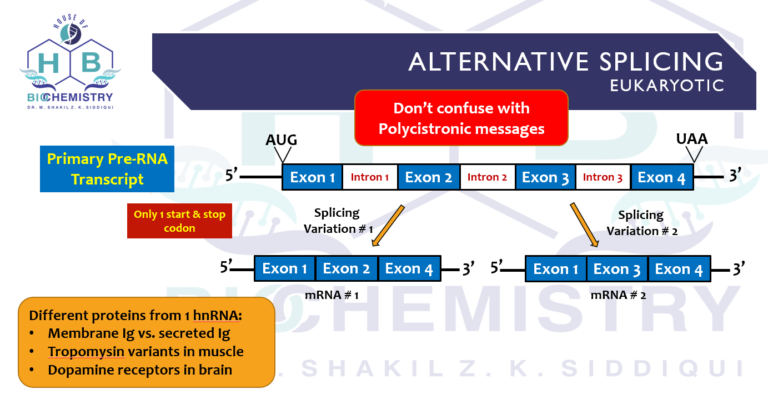
The variations in splicing are shown in the figure along with this lesson.
In Variation 1, there is Exon 1, Exon 2 and Exon 4 come together. So that Intron 1, Intron 2, Exon 3 and Intron 3 are all spliced out. Exon 1, Exon 2 and Exon 4 are linked together.
Variation 2: In the other cell type the exact mRNA is spliced differently so that the Intron 1, Exon 2, Intron 2 and Intron 3 are all spliced out.
In that cell type Exon 1, Exon3 and Exon 4 come together.
So two different types of proteins are produced from one single mRNA.
The amino acid sequence is changed to form different proteins.
Examples of this process in our body are:
- From one single HnRNA, different immunoglobulins can be made.
- Tropomyosin variants in muscles.
- Dopamine receptors in the brain.