Genetics 6 Sections19 LessonsLifetime
Curriculum
- 6 Sections
- 19 Lessons
- Lifetime
Expand all sectionsCollapse all sections
- Introduction2 Items
- Replication1 Item
- Transcription5 Items
- Translation3 Items
- Miscellaneous5 Items
- Gene Expression3 Items
Prokaryotic & Eukaryotic Transcription Units
Prokaryotic & Eukaryotic Transcription Units-Differences
Prokaryotic Transcription Unit
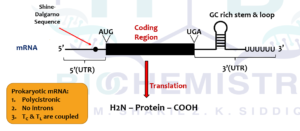
- The Prokaryotic Transcription Unit has a Promoter element and a coding region.
- RNA Polymerase binds to the Promoter region
- Starts transcribing at +1 region
- Reads from 3’ to 5’ and synthesizes 5’ to 3’.
- UTRs are the untranslated regions.
- At terminator sequence mRNA is released.
- At the end of transcription, we get an mRNA that has 5’ to 3’ end.
- At the 5’ end there is 5’ UTR and at 3’ there is 3’UTR.
- In between, there is a coding region that contains the proteins and amino acids information.
Facts about Prokaryotic mRNA
- It may or may not be Polycistronic many that it may contain one or more coded genes on one mRNA.
- There are no Introns-intervening sequences.
- Transcription and Translation are coupled.
- As soon as the mRNA is synthesized it binds with ribosome and starts translating.
*Remember the ribosome is the only structure that READS from 5′ to 3′. Otherwise all the Reading is always from 3′ to 5′.
Protein is synthesized from Amino to Carboxy terminus.
- How does ribosome know where to bind and, where to initiate translation?
- There is a Shine Dalgarno Sequence embedded in the 5’UTR region which is a sequence of nitrogenous bases.
- It binds to ribosomal RNA and starts translating.
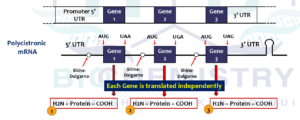
- Prokaryotic mRNA may be Polycistronic.
- There is one Promotor and one terminator sequence for all of the genes with one SD sequence for each.
- A Single mRNA is formed.
- It has 3 distinct genes each with its own SD sequence to translate into 3 different proteins.
- So each of the gene that is transcribed in a single mRNA unit are individually translated by the ribosome.
- It translates 1st gene then dissociates then atteches itself to SD sequence of 2nd gene, translates and then the 3rd.
- In this way 3 types or proteins are produced independently.
- Each gene is translated from its amino terminus to the carboxy terminus.
Eukaryotic Transcription Unit
- The Eukaryotic Transcritption unit is similar to the Prokaryotic unit but with some differences.
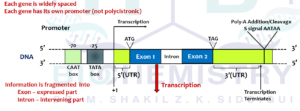
- It also has a promotor region for RNA Polymerase.
- RNA Polymerase initiates the transcription at the +1 site.
- A RNA copy of the DNA is made by this process.
- The template strand is used to transcribe.
- RNA Polymerase reads the template strand from 3′ to 5′ and synthesizes complimentary.
- Each gene is more widely spaced and each has its own promotor and terminator region.
- No polycistronic messages. It is Monocistronic.
- Promoter elements, the TATA box the CAAT box are attached to the coding strand.
- Each gene is more widely spaced in Eukaryotic mRNA as eukaryotic genes are much bigger.
- Each has its own Promoter region as opposed to Prokaryotes.
- Information is fragmented into Exons and Introns.
- Exon is the expressed part of the gene while intron is the intervening part of gene.
- Exons contain all the information for proteins and amino acids.
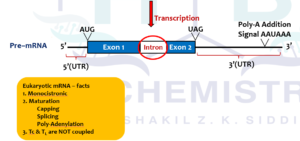
- A mature mRNA will have 5’ UTR and 3’UTR.with intervening exon intron regions.
- Before the mRNA completely matures we call it Pre-mRNA as it still contains the Intron sequence. These are removed on maturation of mRNA.
Things to remember in Eukaryotic mRNA
- They are Monocistronic.
- Maturation: there are 3 steps in maturation:
- Capping
- Splicing
- Poly-Adenylation.
- Transcription and Translation are NOT coupled.
- This is because mRNA is made in the nucleus and when it comes out in the cytoplasm then Translation occurs.