
Genetics 6 Sections19 LessonsLifetime
Curriculum
- 6 Sections
- 19 Lessons
- Lifetime
- Introduction2 Items
- Replication1 Item
- Transcription5 Items
- Translation3 Items
- Miscellaneous5 Items
- Gene Expression3 Items
Regulation of Gene Expression
Introduction
Gene expression is a multistep process that ultimately results in the production of a functional gene product, either RNA or a protein.
The first step in gene expression, transcription, is the primary site of regulation in both prokaryotes and eukaryotes.
In eukaryotes, gene expression also involves extensive post-transcriptional & post-translational processes.
There are also other actions that influence access to particular regions of the DNA.
Each of these steps can be regulated to provide additional control over the kinds and amounts of functional products that are produced.
Points to Note
ALL GENES ARE NOT REGULATED
Constitutive genes encode products required for basic cellular functions and so are continually expressed – “housekeeping” genes.
Regulated genes are expressed only under certain conditions. They may be expressed in all cells or in only a subset of cells e.g. hepatocytes.
The ability to regulate gene expression i.e. to determine if, how much, and when particular gene products will be made, gives the cell control over structure & function.
It is the basis for cellular differentiation, morphogenesis, and adaptability of any organism.
Control of gene expression is best understood in prokaryotes.
But its main themes are repeated in eukaryotes.
Regulatory Sequences and Molecules
Regulation of Transcription
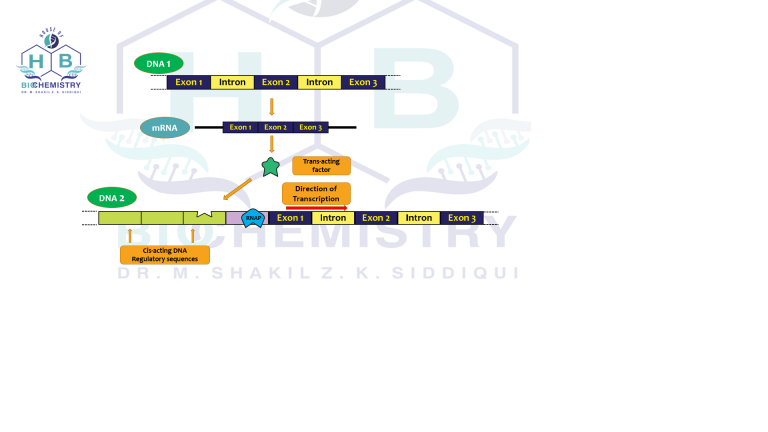
initial step in all gene expression, is controlled by regulatory sequences of DNA, usually embedded in the noncoding regions of the genome.
These regulatory sequences are known as Transcription factors.
These transcription factors, can engage or repress the transcriptional machinery.
They also influence what kind and amount of products that are to be synthesized.
These DNA sequences flanking a gene are called cis-acting because they influence expression of genes only on the same chromosome.
A trans-acting factor is the regulatory molecule itself, which can transit (diffuse) through the cell from its site of synthesis to its DNA-binding site.
Example
A protein transcription factor (a trans-acting molecule) that regulates a gene on chromosome 6 might itself have been produced from a gene on chromosome 11.
The binding of proteins to DNA is through structural motifs.
Some trans-acting factors can negatively affect gene expression.

Regulation of Gene Expression in Prokaryotes
Regulation of gene expression occurs primarily at the level of transcription.
It is mediated by the binding of trans-acting proteins to cis-acting regulatory elements on their single DNA molecule(chromosome).
“Regulating the first step in the expression of a gene is an efficient approach, as energy is not wasted making unneeded gene products”.
Transcriptional control in prokaryotes can involve the initiation or premature termination of transcription.