Post Transcriptional Modifications-mRNA maturation
Post Transcriptional Modifications-Maturation of Pre mRNA
In the previous lesson we discussed the formation of The Eukaryotic pre-mRNA.
The pre-mRNA leaves the nucleus and enters into the cytoplasm to get translated.
But before it is translated it must undergo the maturation process.
This Maturation involves 3 main steps:
Capping
Splicing
Poly Adenylation
Capping, Splicing & Polyadenylation of mRNA
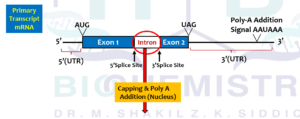
The pre-mRNA can also be called as a Primary transcript but it is not a mature mRNA yet.
The Introns in the pre-mRNA have to be spliced out in order to mature.
Pre-mRNA has to be capped also.
The Cap is placed at the 5′ end of the mRNA and
Finally a Poly A tail is added on the 3′ end to the pre-mRNA.
These 3 maturation steps must take place.
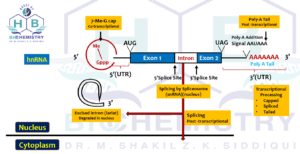
The cap at the 5′ end of the mRNA is called the 7-Methyl Guanosine Cap.
This Cap is added Co-Transcriptionally,
This cap is very unique as there is a specific Tri-phosphate linkage that links the cap at 5′ end.
This Linkage provides protection to the mRNA from getting damaged by enzymes.
The other important function of this cap is to identify the mRNA, so that the rRNA and tRNA can recognize it and ribosome can bind to it for translation to occur.
There is also an addition of a bunch of As to the 3′ end of the mRNA.
This Poly A Tail has 2 functions:
It provides protection to the mRNA like the cap
It helps the mRNA to get out in the cytoplasm.
The Poly A Tail is added Post transcriptionally.
Now to summarize:
Cap is added Co-transcriptionally.
Poly A Tail is added Post-transcriptionally.
There is a debate whether splicing occurs Co- of Post-transcriptionally.
There is a special unit of Proteins called a Spliceosome that cleaves the mRNA at the 5′ and 3′ ends of the Intron.
The Intron is spliced out and forms a Lariat structure which is later degraded in the nucleus by enzymes.
The Exons then come together and join each other to form a mature mRNA.
Spliceosomes are made up of snRNAs (small nuclear RNAs) and SNRNPs (Small Nuclear Ribonuclear Proteins).
These proteins come together and form a spliceosome which removes the Intron.
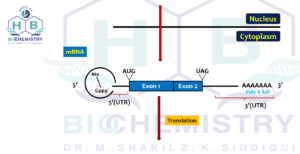
This happens in the nucleus and the mRNA now comes out into the cytoplasm to be translated.
Now the mRNA is mature and ready to be translated.
The ribosome in the cytoplasm identifies the 7 Methyl Guanosine cap and attaches to mRNA, reads the code and translates into a functional protein.
Next topic will be "Alternative Splicing in Eukaryotes"