Phospholipids are classified among the Complex lipids.
On the basis of type of alcohol present in them, phospholipids are of 2 types:
On the basis of different groups present, they are further subdivided into different groups:
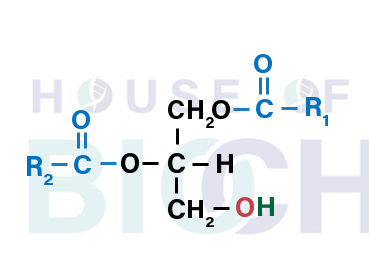
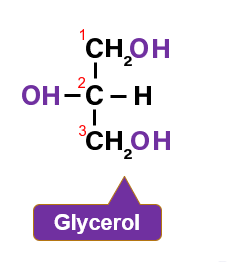
When Glycerol is converted to phosphatidic acid, different groups are attached to the phosphate group at C-3.
According to those attached groups, different types of Glycerophosphates are formed.
When Choline is attached to Phosphatidic acid, Phosphatidylcholine is formed.
This is commonly known as Lecithin.
Lecithin is present in brain, nerve tissue, liver, bile and blood.
It has hydrophobic and hydrophilic groups (PO4 is hydrophilic & R-group is hydrophobic).
Compounds having both hydrophilic & hydrophobic groups are called “AMPHIPATHIC”
They have a role in emulsification of fats.
C-1 has a saturated fatty acid.
C-2 has an unsaturated fatty acid like arachidonic acid – 4 double bonds at position 5, 8, 11, 14.
There is a phosphatidylcholine called “Dipalmitoyl Lecithin”.
It acts as “SURFACTANT” in lungs.
On both positions C-1 & C-2 there is Palmitic acid (R1 & R2).
It is a surface tension lowering agent and keeps the lungs expanded.
It forms after 28 weeks in the developing fetus.
In Premature babies this Dipalmitoyl Lecithin is not formed.
These babies suffer from RDS (Respiratory Distress Syndrome).
RDS is the major cause of death in premature babies.
When instead of choline, ethanolamine is attached to the PO4 group, Cephalin is formed.
It is also present in brain and nerve tissue.
Ethanolamine can be converted into choline by trimethylation.
Lecithin has a big store of choline.
When serine is attached to the phosphate group of phosphatidic acid, phosphatidyl serine is formed.
Serine is one of the three OH-containing amino acids.
It has an important role in apoptosis.
Sometimes threonine is attached instead of serine.
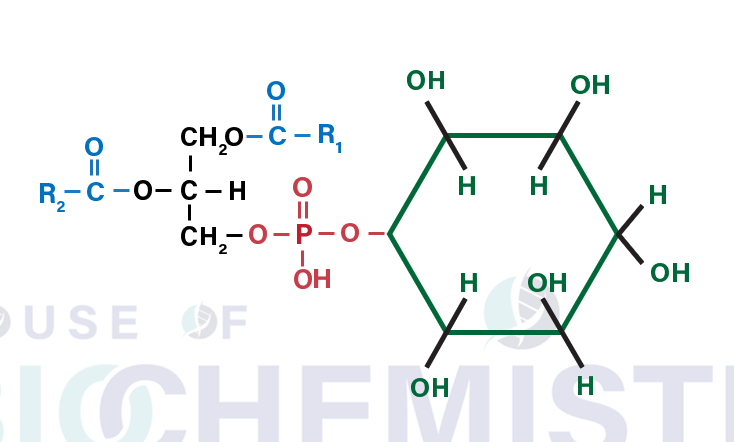
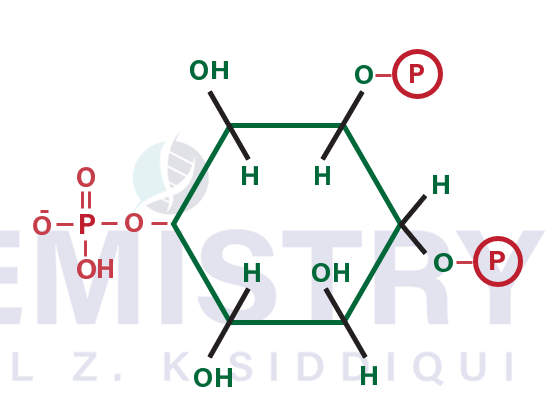
Inositol is 6-C cyclic alcohol with 6 OH groups.
When it is attached with phosphatidic acid, it is called Phosphatidyl Inositol.
One of its type is Phosphatidyl inositol 4,5 bisphosphate – one PO4 attached at 4 and second at 5 position.
When acted upon by the enzyme Phosphatidyl Lipase C, it breaks up the PO4 and by addition of HOH, it forms DAG.
H is added in place of PO4 to form DAG.
Remaining is called as 1,4,5-Inositol Triphosphate (IP3).
DAG activates Protein kinase.
1,4,5-Inositol triphosphate (IP3) acts as a second messenger.
It releases calcium from ER.
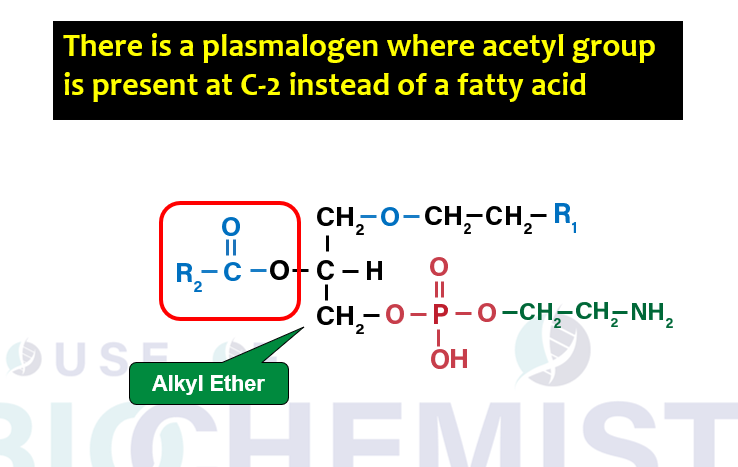
Plasmalogens are present in brain and muscles.
About 10% of phospholipids in brain and muscles are plasmalogens.
In Plasmalogens, instead of ester linkage at C-1, there is an ether linkage (of lecithin) and at C-3 there is ethanolamine.
There are 2 types of Plasmalogens.
There is a plasmalogen where acetyl group is present at C-2 instead of a fatty acid.
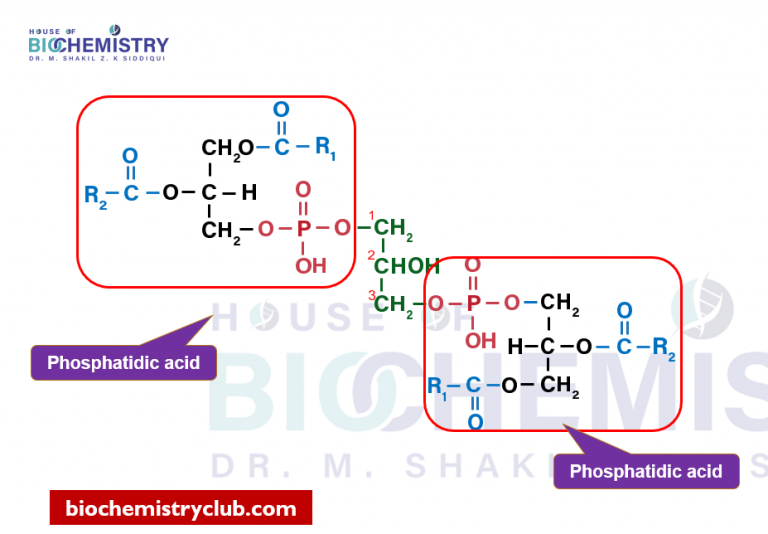
Cardiolipins are present only in mitochondria.
These are Glycerol molecules which have phosphatidic acid at C-1 and C-3.
Deficiency of cardiolipins causes cardiomyopathy leading to cardiac failure.
Comment *
Name*
Email*
Website
Save my name, email, and website in this browser for the next time I comment.
Δ