
Metabolism of Lipids 9 Sections27 LessonsLifetime
Curriculum
- 9 Sections
- 27 Lessons
- Lifetime
- Introduction1 Item
- Lipid Oxidation7 Items
- Biosynthesis of Lipids2 Items
- Cholesterol6 Items
- Lipoproteins5 Items
- Phospholipids2 Items
- Glycosphingolipids1 Item
- Sulfolipids1 Item
- Degradation of Phospholipids & Lipid Storage Diseases2 Items
Eicosanoids
“Eicosa” in Greek means 20.
These are 20-C compounds derived from 20-C PUFA.
Namely:
- Eicosatrienoic acid.
- Eicosatetraenoic acid – major – commonly named as Arachidonic acid.
- Eicosapentaenoic acid.
Essential Fatty acids
- Linoleic acid
- Linolenic acid
- Arachidonic acid
Arachidonic acid
Arachidonic acid is an Essential fatty acid with 4 double bonds.
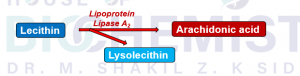
It is derived from lecithin (from cell membrane) from the 2nd position where unsaturated fatty acid is attached.
Arachidonic also comes from diet.
Derivatives of Arachidonic acid
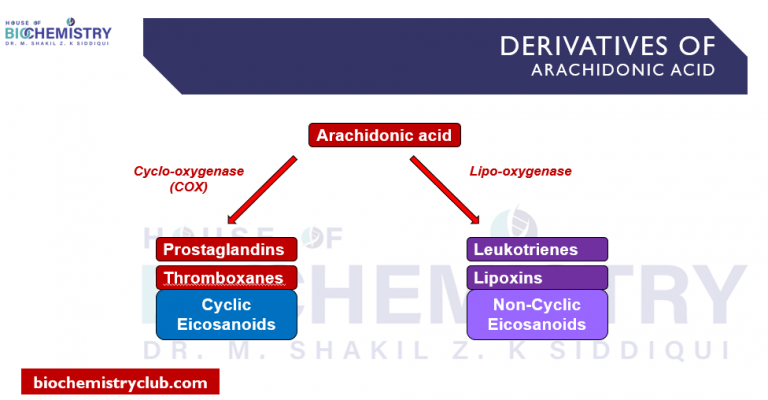
Arachidonic is broken down by 2 types of pathways:
- Cyclo-oxygenase pathway
- Lipo-oxygenase pathway
Cyclo-oxygenase Pathway
When Cyclo-oxygenase (COX) enzyme acts on Arachidonic acid, Cyclic Eicosanoids are formed.
These are Prostaglandins and Thromboxanes.
Lipo-oxygenase Pathway
When Lipo-oxygenase enzyme acts on Arachidonic acid, Non-Cyclic Eicosanoids are formed.
These are Leukotrienes and Lipoxins.
Prostaglandins
PGs were originally isolated from prostate secretions and hence the name.
They are present in almost all tissues.
They are the most potent biologically active substances; as low as one ng/mL of PG will cause smooth muscle contraction.
They are not hormones but have hormone like activity. The diverse physiological roles of prostaglandins confer on them the status of local hormones.
All prostaglandins are derived from the 20 C cyclic saturated fatty acid, prostanoic acid (hypothetical structure).
This structure is formed when C8 and C12 of arachidonic acid combine with each other and a ring is formed and the remaining carbons appear in ta straight chain.
They have 5-C ring. All naturally occurring PGs have an alpha-oriented OH group at C15 but PGH has OOH group at C15.
Classification of Prostaglandins
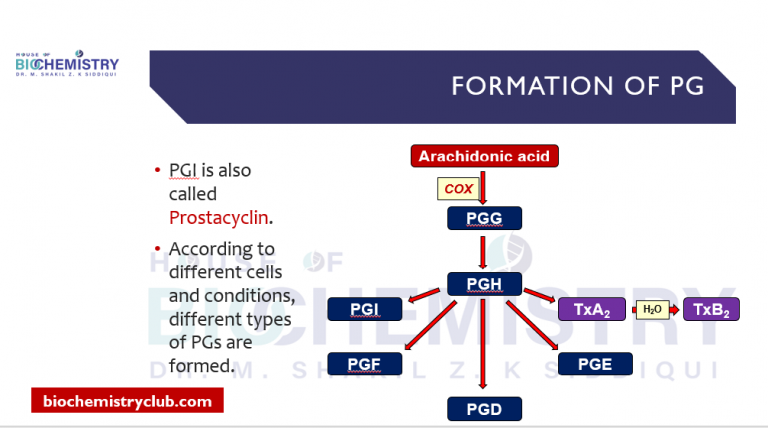
According to the attachment of different substituent groups to the ring, PGs are named with capital letters such as A, B, E and F.
Formation of Prostaglandins
According to different cells and conditions, different types of PGs are formed.
Subclassification
Prostaglandins are further subclassified such as PGE1, PGE2, PGE3.
These are classified as per double bond in the side chain.
PGE1 at 13 position, PGE2 has 2 double bonds at 13 (R2) and 5 (R1) position, PGE3 at 13, 17 (R2) and 5 (R1) position.
PGE1 is formed from Eicosatrienoic acid, PGE2 from Eicosatetraenoic acid (Arachidonic acid) and PGE3 for Eicosapentaenoic acid.
Properties of Prostaglandins
They have hormone like action but not hormones.
They are produced in small amounts and have a very short half life.
They are produced at the site of action.
They are not stored in the body – produced and utilized.
Inhibitors of COX
- Aspirin
- Indomethecin
- Ibuprofen.
COX – Cyclo-oxygenase enzyme
Biological Actions & Clinical Applications of Cyclic Eicosanoids
Effects on CVS
Prostacyclin (PGI2) is synthesized by the vascular endothelium.
Major effect is vasodilatation.
It also inhibits platelet aggregation and has a protective effect on vessel wall against deposition of platelets.
But any injury to the vessel wall would inhibit PGI2 synthesis so that platelet aggregation occurs to promote thrombus formation.
Thromboxane (TXA2 ) is the main PG produced by platelets.
The major effects are vasoconstriction and platelet aggregation.
Prostacyclin and thromboxane are opposing in activity.
Prostaglandins lower the blood pressure.
Effects on Ovary and Uterus
The PGF2 stimulates the uterine muscles.
PGF2 may be used for medical termination of pregnancy.
Another use is in inducing labor and arresting postpartum hemorrhage.
PGs are also used in LH induced ovulation.
Effects on Respiratory Tract
The PGF is a constrictor of bronchial smooth muscle.
But PGE is a potent bronchodilator.
PGE series are used in aerosols for relieving bronchospasm.
Effects on Immunity & Inflammation
The PGE2 and PGD2 produce inflammation by increasing capillary permeability.
Erythema and wheal are produced at the site of injury.
PGE2 reduces both T and B cell functions.
PGE2 is a sleep promoting substance.
Effects on GIT
PGs inhibit gastric secretion and increase intestinal motility.
The inhibitory effect on gastric secretion is used therapeutically in treatment of acid peptic disease.
Diarrhea may be an unwanted side effect.
Metabolic Effects
The metabolic effects are through the action of hormones by the modulating effect on cAMP production.
PGE2 decreases lipolysis, increases calcium mobilization from bone and glycogen synthesis.
Non-Cyclic Eicosanoids
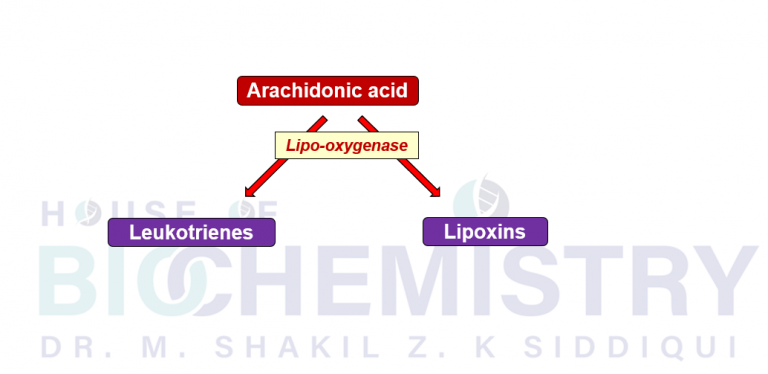
Non-cyclic eicosanoids are formed through the Lipo-oxygenase Pathway.
Leukotrienes
These are non-cyclic compounds produced form arachidonic acid.
It has 4 double bonds, 3 are alternate but 4th is not.
These are further subclassified.
LTB4 is produced in neutrophils; it is the most potent chemotactic agent (factor attracting cells to the inflammatory site).
The Slow Reacting Substance of Anaphylaxis (SRS-A) contains LTC4, LTD4 and LTE4 .
They cause smooth muscle contraction, constrict the bronchioles, increase capillary permeability, activate leukocytes and produce vasoconstriction.
SRS-A is the mediator of hypersensitivity reactions such as asthma.
Lipoxins
They are a produced by leukocytes.
These are also subclassified e.g. LXA, LXC, LXD, LXE
LXA4 is the most common variety.
It is anti-inflammatory and decreases immune response.
Very helpful🤞🤞
👍👍👍