
Metabolism of Lipids 9 Sections27 LessonsLifetime
Curriculum
- 9 Sections
- 27 Lessons
- Lifetime
- Introduction1 Item
- Lipid Oxidation7 Items
- Biosynthesis of Lipids2 Items
- Cholesterol6 Items
- Lipoproteins5 Items
- Phospholipids2 Items
- Glycosphingolipids1 Item
- Sulfolipids1 Item
- Degradation of Phospholipids & Lipid Storage Diseases2 Items
Cholesterol metabolism
Biomedical Importance of Cholesterol
Cholesterol is present in tissues and plasma as free cholesterol or combined with LCFA (Long chain fatty acids) as cholesterol ester (storage form).
Both forms in plasma are transported in lipoproteins.
It is an important and essential component of cell membranes – maintains correct permeability and fluidity.
It is also an important component of plasma lipoproteins.
Synthesized in many tissues from Acetyl CoA.
Precursor of all other steroids in the body including corticosteroids, sex hormones, bile acids and Vitamin D.
It is found in foods of animal origin – egg yolk, meat, liver and brain.
Plasma LDL is the transport vehicle of cholesterol to many tissues.
Free cholesterol is removed from tissues & taken to liver by HDL.
From liver it is eliminated from the body either unchanged or after conversion to bile acids (reverse cholesterol transport).
Cholesterol is the major constituent of gall stones.
It is the main cause of atherosclerosis of vital arteries causing Cerebrovascular accidents, Coronary artery disease and Peripheral vascular disease.
Synthesis of Cholesterol
A little more than half is synthesized (700 mg), the remaining is taken from average diet.
Liver and intestine synthesize around 10%.
All nucleated cells can synthesize cholesterol in ER and cytosolic compartments.
Cholesterol is a 27-C compound synthesized from acetyl CoA by a lengthy process.
Steps of Synthesis of Cholesterol
There are a lot of steps involved in the synthesis of cholesterol and they are difficult to remember.
For academic purpose we can divide this pathway into some major steps.
Step 1: Synthesis of HMG Co A.
Step 2: Synthesis of mevalonate from acetyl CoA.
Step 3: Formation of isoprenoid units from mevalonate.
Step 4: Condensation of 6 isoprenoid units to form Squalene,
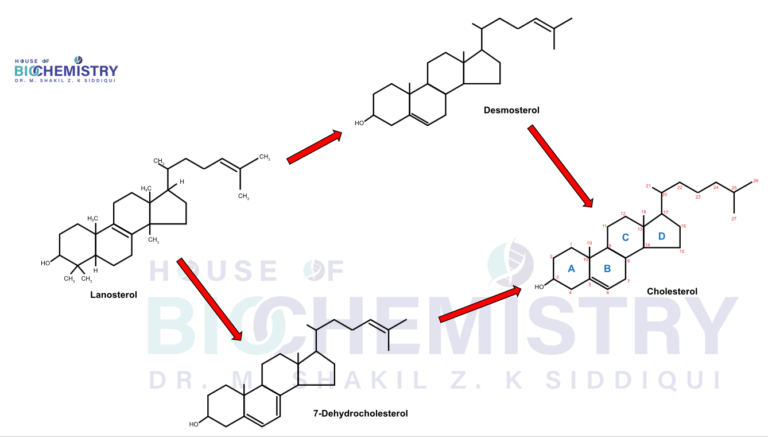
Step 5: Cyclization of Squalene to form parent steroid – Lanosterol
Step 6: Formation of Cholesterol form Lanosterol.
Step 1: Synthesis of HMG CoA (3-Hydoxy-3-Methylglutaryl CoA)
The first two reactions in the cholesterol synthetic pathway are similar to those in the pathway that produces ketone bodies.
They result in the production of 3-hydroxy-3-methylglutaryl CoA (HMG CoA).
The difference is that this reaction takes place in cytosol while that for ketone bodies takes place in the mitochondria.
First, two acetyl CoA (2-C) molecules condense to form acetoacetyl CoA (4-C).
Next, a third molecule of acetyl CoA is added by HMG CoA synthase, producing HMG CoA,
a six-carbon compound. (Liver parenchymal cells contain two isoenzymes of the synthase . The cytosolic enzyme participates in cholesterol synthesis, whereas the mitochondrial enzyme functions in the pathway for ketone body synthesis).
Step 2: Synthesis of Mevalonate
In the next step, the HMG CoA is reduced to mevalonate, catalyzed by HMG CoA reductase.
This the rate limiting and key regulatory step, occurs in the cytosol.
Two molecules of NADPH are used as the reducing agent, CoA is released, making the reaction irreversible.
HMG CoA reductase is an integral membrane protein of the ER, with its catalytic domain projecting into the cytosol.
Step 3: Synthesis of Isoprenoid units from mevalonate
Mevalonate is converted to 5-pyrophosphomevalonate in two steps, each of which transfers a phosphate group from ATP.
A five-carbon isoprene unit, isopentenyl pyrophosphate (IPP), is formed by the decarboxylation of 5-pyrophosphomevalonate (ATP required – kinases help in these reactions).
IPP is the precursor of a family of molecules the isoprenoids.
Cholesterol is a sterol isoprenoid.
Nonsterol isoprenoids include dolichol and ubiquinone (Coenzyme Q)

Step 4: Condensation of 6 isoprenoid units to form Squalene
IPP (5C) is isomerized to 3,3-dimethylallyl pyrophosphate (DPP). Enzyme is isomerase. It is a reversible reaction.
IPP (5C) and DPP (5C) condense to form 10-C Geranyl pyrophosphate (GPP) – enzyme is transferase.
A second molecule of IPP (5C) then condenses with GPP (10C) to form 15-C Farnesyl pyrophosphate (FPP) – enzyme is transferase.
Two molecules of FPP (15C) combine, releasing pyrophosphate, and are reduced, forming the 30-carbon compound Squalene. This reaction is facilitated by Squalene Synthase.
Squalene is formed from six isoprenoid units. Because three ATP are hydrolyzed per mevalonate residue converted to IPP, a total of 18 ATP are required to make the Polyisoprenoid squalene.
Step 5: Cyclization of Squalene to form parent steroid - Lanosterol
Squalene is converted to the sterol Lanosterol by a sequence of
reactions catalyzed by ER-associated enzymes that use molecular oxygen and NADPH.
The hydroxylation of linear squalene triggers the cyclization of the structure to lanosterol.
Step 6: Formation of Cholesterol from Lanosterol
The conversion of lanosterol to cholesterol is a multistep, ER-associated process involving:
- Shortening of the side-chain,
- Oxidative removal of methyl groups,
- Reduction of double bonds, and
- Migration of a double bond.
Regulation of Cholesterol synthesis
HMG CoA reductase is the major control point for cholesterol biosynthesis and is subject to different kinds of metabolic control.
- Sterol-dependent regulation of gene expression.
- Sterol-accelerated enzyme degradation.
- Sterol-independent phosphorylation/dephosphorylation.
- Hormonal regulation.
- Inhibition by drugs.
1. Sterol-dependent regulation of gene expression.
- When sterol level in the cells are low, there is increased synthesis of HMG CoA reductase and therefore increased cholesterol synthesis.
- When the sterol in the cells is abundant, there is down regulation of cholesterol synthesis.
2. Sterol-accelerated enzyme degradation.
HMG CoA reductase itself is sterol sensing integral protein of the ER membrane.
When sterol levels are high, the enzyme is inactivated by binding to a specific protein.
This results in ubiquitination and proteasomal degradation of the enzyme.
3. Sterol-independent phosphorylation/dephosphorylation
HMG CoA reductase activity is covalently controlled through the actions of AMP-activated protein kinase & phosphoprotein phosphatase.
When phosphorylated, it is inactive while, dephosphorylated, it is ACTIVE.
4. Hormonal regulation
- HMG CoA reductase activity is also controlled hormonally.
- An increase in insulin and thyroxine favors upregulation or the gene for the enzyme.
- Glucagon and glucocorticoids have the opposite effect.
5. Inhibition by drugs
The statin drugs (atorvastatin, simvastatin etc.) are structural analogues of HMG CoA reductase.
These are reversible competitive inhibitors of the enzyme.
Used to lower the plasma cholesterol level in patients with hypercholesteremia.
Very helpful. May God bless u🤞