
Metabolism of Lipids 9 Sections27 LessonsLifetime
Curriculum
- 9 Sections
- 27 Lessons
- Lifetime
- Introduction1 Item
- Lipid Oxidation7 Items
- Biosynthesis of Lipids2 Items
- Cholesterol6 Items
- Lipoproteins5 Items
- Phospholipids2 Items
- Glycosphingolipids1 Item
- Sulfolipids1 Item
- Degradation of Phospholipids & Lipid Storage Diseases2 Items
Degradation of Phospholipids
Degradation of Phospholipids
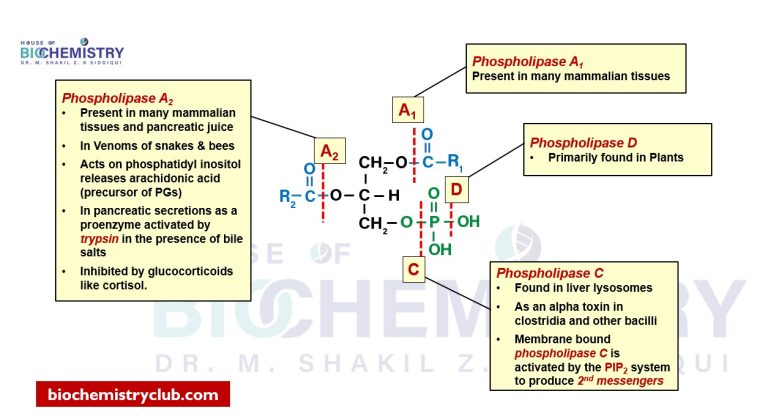
A number of different enzymes act on different places.
These can be better understood by the following diagram:
Degradation of Sphingomyelin

Diseases associated with enzyme deficiency
Niemann-Pick disease - Type A
In the severe infantile form, Type A (which shows less than 1% of normal enzymic activity), the liver and spleen are the primary sites of lipid deposits and are, therefore, greatly enlarged.
Sphingomyelin is the major lipid that cannot be degraded.
Infants with this lysosomal storage disease experience rapid and progressive neurodegeneration as a result of deposition of sphingomyelin in the CNS, and they die in early childhood.
Niemann-Pick disease - Type B
Type B is a less severe variant (which shows 5% or more of normal enzymic activity).
It has later age of onset and a longer survival time.
Causes little to no damage to neural tissue, but lungs, spleen, liver, and bone marrow are affected, resulting in a chronic form of the disease.
Although Niemann-Pick disease occurs in all ethnic groups, Type A occurs with greater frequency in the Ashkenazi Jewish population.
Degradation of Glycosphingolipids
Glycosphingolipids are internalized by endocytosis and undergo degradative process by enzymes present in lysosomes, which fuse with the endocytotic vesicles.
The lysosomal enzymes hydrolytically and irreversibly cleave specific bonds in the glycosphingolipids.
Degradation is a sequential process following the rule “last on, first off,” in which the last group added during synthesis is the first group removed in degradation.
Defects in the degradation of the polysaccharide chains in these three glycoconjugates , therefore, result in lysosomal storage diseases.
Normally, synthesis and degradation of glycosphingolipids are balanced, so that the amount of these compounds present in membranes is constant.
If a specific lysosomal acid hydrolase required for degradation is partially or totally missing, a sphingolipid accumulates.
Lysosomal lipid storage diseases caused by these deficiencies are called sphingolipidoses.
The results may be seen in nerve tissue – neurologic deterioration can lead to early death.