
Metabolism of Lipids 9 Sections27 LessonsLifetime
Curriculum
- 9 Sections
- 27 Lessons
- Lifetime
Expand all sectionsCollapse all sections
- Introduction1 Item
- Lipid Oxidation7 Items
- Biosynthesis of Lipids2 Items
- Cholesterol6 Items
- Lipoproteins5 Items
- Phospholipids2 Items
- Glycosphingolipids1 Item
- Sulfolipids1 Item
- Degradation of Phospholipids & Lipid Storage Diseases2 Items
Bile Acids Metabolism
Bile acids
- Produced from cholesterol
- Occurs in liver
- 70 – 80% of liver cholesterol is converted to bile acids
- Classic (Neutral pathway) and Alternative (Acidic Pathway)
Biomedical Importance
- Emulsification of fats/lipids.
- Absorption of fat soluble vitamins.
- Digestion and absorption of fats/lipids.
- Prevention of cholesterol precipitation.
- Elimination of cholesterol.
Synthesis of Bile acids
- Bile acids are synthesized from cholesterol which is a 27-C compound.
Synthesis of Cholic acid
- In the first step the Hydroxyl group (OH) is switched from β-position to α-position.
- In the next step an OH is added at α-position at Carbon-7 to form 7-α-Hydroxycholesterol.
- Enzyme is Cholesterol 7-α-hydroxylase (CYP7A).
- For the formation of Cholic acid there is one extra step before that that is addition of OH at C-12 by 12–α-Hydroxylase.
- Side chain is also modified in several steps and carboxyl group is added at its end to form Cholic acid. This occurs after a number of steps, enzymes involved are CYP8B1 & CYP27A1. Oxygen, 2NADPH & 2 CoASH are added with release of Propionyl-CoA.
Synthesis of Chenodexycholic acid
- For the synthesis of Chenodoxycholic acid all the steps are same except step no. 4.
- This step does not take place as it has one less OH at C-12.
- In the last step (no. 5), the enzyme is CYP27A1.
- In the formation of Chenodeoxycholic acid, there is another pathway that takes place through mitochondria.
- First 27-Hydroxycheolesterol is formed by the enzyme Sterol 27-Hydoxylase (CYP27A1).
- Next Chenodoxycholic acid is formed by action of enzyme CYP7B1.
NOTE: Cholic acid and Chenodeoxycholic acid are the Primary Bile acids.
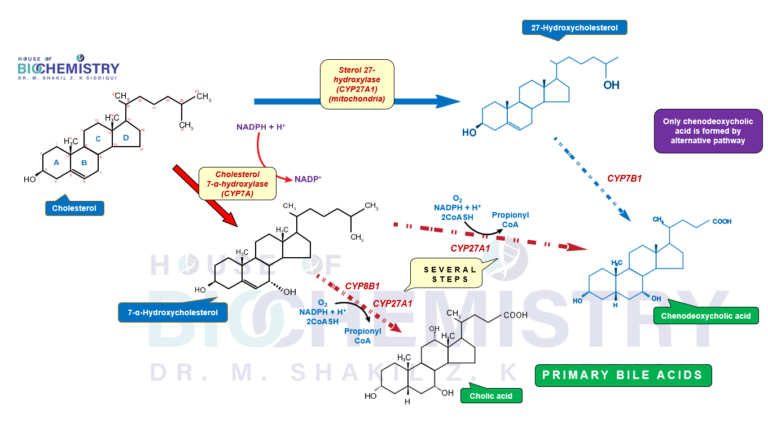
Figure - Synthesis of Primary Bile acids
Synthesis of Secondary Bile acids
- These Primary bile acids are then conjugated to Glycine and Taurine.
- They enter the the intestine along with bile and there they are then combined with Sodium and Potassium to form Bile salts.
- Bile salts help in emulsification of fats to form micelles for their digestion.
- In the intestine the Bile acids are acted upon by the bacteria to form Secondary bile salts (Cholic acid to Deoxycholic acid & Chenodeoxycholic acid forms Lithocholic acid).
Entero-hepatic Circulation of Bile acids
- Bile salts secreted into the intestine are efficiently reabsorbed (greater than 95%) and reused.
- The liver actively secretes bile salts into the bile.
- In the intestine, they are reabsorbed in the terminal ileum via a
Na+– bile salt cotransporter and returned to the blood via a separate transport system. (Lithocholic acid is poorly absorbed). - They are efficiently taken up from blood by the hepatocytes via an isoform of the cotransporter and reused – Albumin binds bile salts noncovalently and transports them through the blood.
The continuous process of secretion of bile salts into the bile,
their passage through the duodenum where some are deconjugated then dehydroxylated to secondary bile salts,
their uptake in the ileum, and
their subsequent return to the liver as a mixture of primary and secondary forms is termed the enterohepatic circulation.
Excretion of Bile acids
- Between 15 and 30 g of bile salts are secreted from the liver into the duodenum each day, yet only about 0.5 g (less than 3%) is lost daily in the feces.
- Approximately 0.5 g/day is synthesized from cholesterol in the liver to replace the amount lost.
- Bile acid sequestrants, such as cholestyramine, bind bile salts in the gut; prevent their reabsorption and promote their excretion.
Easy to understand..well explained.Great work !