Metabolism of Lipids 9 Sections27 LessonsLifetime
Curriculum
- 9 Sections
- 27 Lessons
- Lifetime
- Introduction1 Item
- Lipid Oxidation7 Items
- Biosynthesis of Lipids2 Items
- Cholesterol6 Items
- Lipoproteins5 Items
- Phospholipids2 Items
- Glycosphingolipids1 Item
- Sulfolipids1 Item
- Degradation of Phospholipids & Lipid Storage Diseases2 Items
LDL (Low Density Lipoproteins)
LDL particles contain much less TAG than VLDL and, they have a high concentration of cholesterol and cholesteryl esters.
Primary function of LDL is to provide cholesterol to the peripheral tissues (or return it to liver).
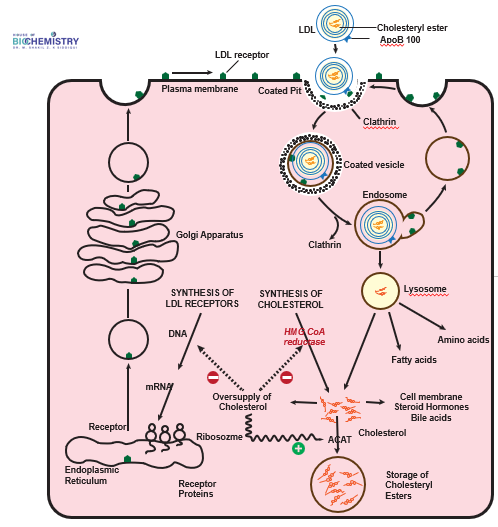
It is done by binding to cell surface membrane receptors (Apo B-100) – Receptor mediated endocytosis.
LDL receptors can also bind to Apo E.
The mechanism of receptor mediated endocytosis is similar to the cellular uptake and degradation of chylomicrons’ remnants and IDL by the liver.
LDL receptors are negatively charged glycoproteins that are clustered in pits on cell membranes. The cytosolic side of the pit is coated with the protein clathrin, which stabilizes the pit.
After binding, the LDL–receptor complex is taken in by endocytosis.
The vesicle containing LDL loses its clathrin coat and fuses with other similar vesicles, forming larger vesicles called endosomes.
The pH of the endosome falls (due to the proton-pumping activity of endosomal ATPase ), which allows separation of the LDL from its receptor.
The receptors then migrate to one side of the endosome, whereas the LDLs stay free within the lumen of the vesicle.
This structure is called CURL, the Compartment for Uncoupling of Receptor and Ligand.
The receptors can be recycled, whereas the lipoprotein remnants in the vesicle are transferred to lysosomes and degraded by lysosomal acid hydrolases, releasing free cholesterol, amino acids, fatty acids, and phospholipids.
These compounds can be reutilized by the cell.
Storage diseases caused by rare autosomal-recessive deficiencies in the ability to hydrolyze lysosomal cholesteryl esters (late -onset Wolman disease ), or
to transport free cholesterol out of the lysosome (Niemann-Pick disease, Type C) have been identified.