
Hormones & Signal Transduction 5 Sections28 LessonsLifetime
Curriculum
- 5 Sections
- 28 Lessons
- Lifetime
- Lecture 012 Items
- Signaling and Signal Transduction7 Items
- Hypothalamic & Pituitary Hormones3 ItemsIn this section we will discuss the hypothalamic endocrine control on varoius hormones secretin. After that the hormones of the posterior pituitary gland, the antidiuretic hormone and oxytocin, will be discussed individually.
- Hormones of the Anterior Pituitary Gland12 ItemsHere we will discuss the Hormones of Anterior Pituitary gland, their secretion, functions and control in various organs
- 4.1The Growth Hormone
- 4.2Gigantism
- 4.3Acromegaly
- 4.4Dwarfism
- 4.5Corticotropin (ACTH)
- 4.6Prolactin – Somatomammotropin
- 4.7FSH – Gonadotropins
- 4.8LH-Luteinizing Hormone
- 4.9Thyroid Stimulating Hormone – TSH
- 4.10The Thyroid (Part 1) – Synthesis & Secretion of Thyroxine
- 4.11The Thyroid (Part 2) – Metabolic effects of Thyroid hormone; Hyperthyroidism
- 4.12The Thyroid (Part 3)-Hypothyroidism, Myxedema, Cretinism
- Steroid Hormones4 ItemsThis section will be on the steroid hormones, their synthesis, secretion, transport, actions on different organs, mechanism of action of steroid hormones, abnormalities of steroid hormones and their management.
The Insulin Pathway
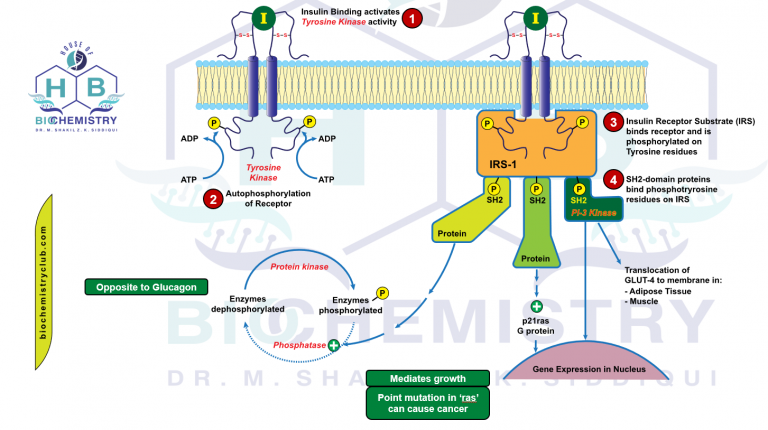
The Insulin Pathway - Description
When insulin comes and binds with the insulin receptors. They come together (dimerize).
These receptors are turned on by the binding if the insulin.
These receptors are tyrosine kinase receptors. That means they have protein kinase activity.
These tyrosine kinase receptors when activated by the insulin phosphorylate themselves on the tyrosine residues of the receptor itself.
This is called autophosphorylation of the receptors.
This tyrosine kinase is part of the receptor.
The phosphorylated receptor now binds to the Insulin Receptor Substrate (IRS).
This is IRS-1.
Once the IRS-1 docks on the receptor, it itself gets phosphorylated on its tyrosine residues by the tyrosine kinase.
When it is phosphorylated, it binds the SH2 domains on its phosphorylated tyrosine residues.
There are so many different types of SH2 domains.
One SH2 domains binds and activates a protein, that after so many steps activates the protein phosphatase (opposite to glucagon).
The other SH2 domain that binds to IRS-1 activates another protein known as the p21ras protein (it is a G protein). It mediates growth. If there is mutation in this protein, then it is the most common cause of cancer.
The third SH2 domain that bonds to the IRS-1 receptor is known as PI-3 kinase.
This is the actual proteins that is involved in the translocation of GLUT-4 receptors in the cell membrane of the adipocyte and the fast twitch skeletal muscle fibers.
Insulin increases the glucose uptake into these tissues and decreases glucose level in the blood.
This glucose is used by the tissues for ATP production.
Diabetes occurs when there is an absence of insulin (Type I) or there is some defect signal transduction (Type II).
The PI-3 kinase is also involved in gene expression.
The growth factors IGF, EGF, PDGF and insulin all depend on the tyrosine kinase activity.