Hormones & Signal Transduction 5 Sections28 LessonsLifetime
Curriculum
- 5 Sections
- 28 Lessons
- Lifetime
- Lecture 012 Items
- Signaling and Signal Transduction7 Items
- Hypothalamic & Pituitary Hormones3 ItemsIn this section we will discuss the hypothalamic endocrine control on varoius hormones secretin. After that the hormones of the posterior pituitary gland, the antidiuretic hormone and oxytocin, will be discussed individually.
- Hormones of the Anterior Pituitary Gland12 ItemsHere we will discuss the Hormones of Anterior Pituitary gland, their secretion, functions and control in various organs
- 4.1The Growth Hormone
- 4.2Gigantism
- 4.3Acromegaly
- 4.4Dwarfism
- 4.5Corticotropin (ACTH)
- 4.6Prolactin – Somatomammotropin
- 4.7FSH – Gonadotropins
- 4.8LH-Luteinizing Hormone
- 4.9Thyroid Stimulating Hormone – TSH
- 4.10The Thyroid (Part 1) – Synthesis & Secretion of Thyroxine
- 4.11The Thyroid (Part 2) – Metabolic effects of Thyroid hormone; Hyperthyroidism
- 4.12The Thyroid (Part 3)-Hypothyroidism, Myxedema, Cretinism
- Steroid Hormones4 ItemsThis section will be on the steroid hormones, their synthesis, secretion, transport, actions on different organs, mechanism of action of steroid hormones, abnormalities of steroid hormones and their management.
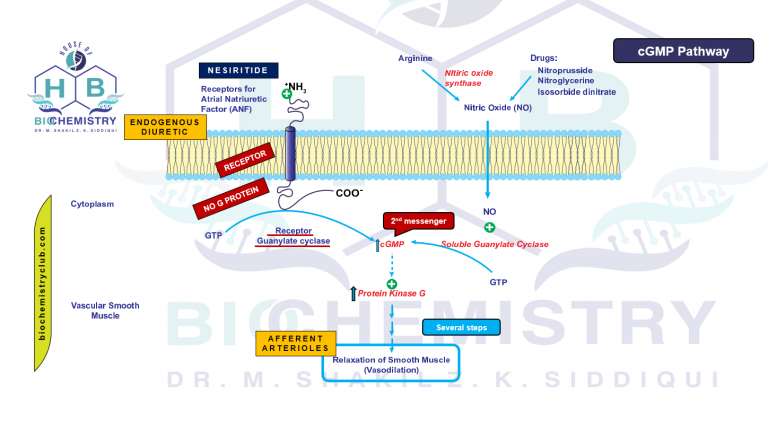
The cGMP Pathway
To explain the cGMP Pathway we will take two examples.
- The Nitric Oxide (NO) and,
- The Atrial Natriuretic Factor (ANF)
1. The Nitric Oxide (NO)
Nitric Oxide is formed from Arginine by the enzyme Nitric Oxide synthase.
Nitric Oxide is a gas and can pass through the membrane easily.
So, NO RECEPTOR needed.
And as a result there is no G-Protein.
In a smooth muscle cell there is an enzyme that is found in the cytoplasm known as Soluble Guanylate Cyclase.
This Soluble Guanylate Cyclase is Heme containing enzyme.
The Nitric Oxide after entering the smooth muscle cell will stimulate the enzyme Guanylate Cyclase.
Guanylate Cyclase in turn will form GTP that will activate the cGMP.
The cGMP is the 2nd messenger.
The cGMP activates Protein Kinase G.
The Protein Kinase G after several steps will cause the relaxation of smooth muscles that will result in vasodilation.
Effects
Arterioles
It will decrease Total peripheral resistance (TPR) and hence will cause decrease in Blood pressure.
Veins
In veins it will decrease the preload resulting in decreased Cardiac output.
Drugs that act through this pathway
- Nitroprusside.
- Nitroglycerine.
- Isosorbide dinitrate.
- Hydralazine.
2. The Atrial Natriuretic Factor (ANF)
The receptor for ANF is a protein receptor having a single domain that goes through the cell membrane.
The ANF (also known as atrial natriuretic peptide) is the Endogenous diuretic.
There is no G Protein.
There is enzyme attached to the receptor itself.
It is the Receptor Guanylate Cyclase enzyme.
This enzyme increases the GTP that in turn will increase the cGMP (second messenger).
The cGMP will activate the Protein Kinase G which after several steps will cause the relaxation of smooth muscles of afferent arterioles.
Nesiritide is the synthetic analogue(drug) of the Atrial Natriuretic Factor that can be given in time of need.