
Vitamins 4 Sections23 LessonsLifetime
Curriculum
- 4 Sections
- 23 Lessons
- Lifetime
Expand all sectionsCollapse all sections
- Introduction2 Items
- Fat Soluble Vitamins12 ItemsThis Section will cover Fat soluble Vitamins A, D, E, and K
- 3.1Vitamin A
- 3.2Vitamin A-Absorption, transport and uptake by the tissues
- 3.3Vitamin A-Biochemical Role
- 3.4Deficiency Manifestations of Vitamin A
- 3.5Hypervitaminosis A (Vitamin A Toxicity)
- 3.6Sources and Daily Requirement of Vitamin A
- 3.7Vitamin D-Cholecalciferol
- 3.8Functions of Vitamin D
- 3.9Deficiency of Vitamin D
- 3.10Vitamin D-Sources, Daily requirement and Toxicity
- 3.11Vitamin E
- 3.12Vitamin K
- Water Soluble Vitamins-Non B-Complex1 ItemIn this section we will discuss the Non B Complex Water soluble vitamin. There is only one in this category that is Vitamin C or Ascorbic acid.
- B Complex Vitamins-Water Soluble Vitamins8 ItemsIn this section all of the B complex vitamins will be discussed along with their biochemical role and deficiency manifestations.
Vitamin D-Cholecalciferol
- Vitamin D is classified in the Fat Soluble Vitamins.
- Is Vitamin D really a Vitamin of a Hormone?
- Because by definition a Vitamin cannot be synthesized in the body and msut be taken in food.
- But Vitamin D is synthesized in the skin with the help of sunlight.
- Vitamin D is also called the “SUN-SHINE VITAMIN”.
Sources of Vitamin D
- Vitamin D is derived either from 7-dehydrocholesterol or Ergosterol by the action of ultraviolet radiations.
- 7-dehydrocholesterol is found in skin and converted to active Vitamin D3 by UV light (Sun).
Commercially the vitamin is derived from the fungus, ergot.
The ergosterol when treated with ultraviolet light, ergocalciferol or vitamin D2 is produced.
Ergocalciferol differs in having an unsaturation in the side chain and an extra methyl group (C28).
Synthesis of Vitamin D
- 7-dehydrocholesterol which is an intermediate of a minor pathway of cholesterol synthesis, is available in the Malpighian layer of epidermis.
- In the skin, ultraviolet light (290–315 nm) breaks the bond between position 9 & 10 of the steroid ring.
- The ring B is opened, to form the provitamin, Secosterol.
- The cis double bond between 5th & 6th carbon atoms, is then isomerized to a trans double bond (rotation on the 6th carbon atom) to give rise to Vitamin D3 or cholecalciferol.
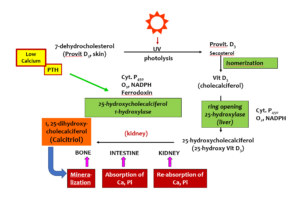
Activation of Vitamin D
- Vitamin D is a prohormone.
- The cholecalciferol is first transported to liver, where hydroxylation at 25th position occurs, to form 25-hydroxy cholecalciferol.
- (The hepatic 25-hydroxylase is a microsomal mono-oxygenase and product of gene CYP27A1. It requires cytochrome P-450 and NADPH)
- 25-hydroxy cholecalciferol is the major storage form.
- In plasma, 25-hydroxy cholecalciferol is bound to “Vitamin D Binding Protein” (VDBP), an alpha-2 globulin.
- In the kidney, it is further hydroxylated at the 1st position.
- (The 1-alpha hydroxylase is located in mitochondria of proximal convoluted tubules and a product of the gene CYP27B1. It requires cytochrome P- 450, NADPH and ferrodoxin (an iron-sulfur protein)).
- Thus 1, 25-dihydroxy cholecalciferol (DHCC) is generated.
- As it contains three hydroxyl groups at 1, 3 and 25 positions, it is also called Calcitriol.
- The calcitriol formed is the active form of vitamin; it is a hormone.
- 24, 25-dihydroxy cholecalciferol may be formed by hydroxylation of 25-hydroxy cholecalciferol at the 24th position, a relatively inactive product.
- PTH is released in response to low serum calcium and induces the production of calcitriol.
- In contrast, reduced levels of PTH stimulate synthesis of the inactive 24, 25-dihydroxy D3.