
Vitamins 4 Sections23 LessonsLifetime
Curriculum
- 4 Sections
- 23 Lessons
- Lifetime
Expand all sectionsCollapse all sections
- Introduction2 Items
- Fat Soluble Vitamins12 ItemsThis Section will cover Fat soluble Vitamins A, D, E, and K
- 3.1Vitamin A
- 3.2Vitamin A-Absorption, transport and uptake by the tissues
- 3.3Vitamin A-Biochemical Role
- 3.4Deficiency Manifestations of Vitamin A
- 3.5Hypervitaminosis A (Vitamin A Toxicity)
- 3.6Sources and Daily Requirement of Vitamin A
- 3.7Vitamin D-Cholecalciferol
- 3.8Functions of Vitamin D
- 3.9Deficiency of Vitamin D
- 3.10Vitamin D-Sources, Daily requirement and Toxicity
- 3.11Vitamin E
- 3.12Vitamin K
- Water Soluble Vitamins-Non B-Complex1 ItemIn this section we will discuss the Non B Complex Water soluble vitamin. There is only one in this category that is Vitamin C or Ascorbic acid.
- B Complex Vitamins-Water Soluble Vitamins8 ItemsIn this section all of the B complex vitamins will be discussed along with their biochemical role and deficiency manifestations.
Vitamin A-Biochemical Role
The major biochemical role or you can say the functions of Vitamin A are:
- Vision/Visual cycle.
- Growth.
- Reproduction.
- Maintenance of epithelial cells and many more.
We will discuss them later.
First we will discuss the visual cycle that is the most important topic (also from the examination view point)
Wald's Visual cycle
Generation of nerve impulse
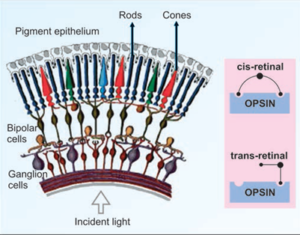
- Rhodopsin with a mol.wt. 35,000 D is a membrane protein found in the photoreceptor cells of the retina.
- Rhodopsin is made up of the protein opsin & 11-cis-retinal
- When light falls on the retina, the 11-cis-retinal isomerizes to all-trans-retinal. A single photon can excite the rod cell.
- The photon produces immediate conformational change.
- The unstable intermediates produced are:
- Rhodopsin → Bathorhodopsin → Lumirhodopsin → Metarhodopsin-I → Metarhodopsin-II → and finally Opsin + all-transretinal.
- Each of these intermediaries has a lifespan of only few picoseconds to microseconds.
- The all-transretinal is then released from the protein.

Mechanism of Action of Vitamin A
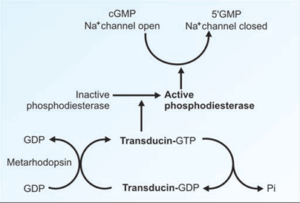
- Visual pigments are G-protein-coupled receptors and 11-cis retinal locks the receptor protein (opsin) in its inactive form.
- The isomerization and photo-excitation leads to activation of G-protein and generation of cyclic-GMP.
- Cyclic GMP acts as the gate for cation specific channels.
- Transducin is the G-protein in retina.
- The nerve impulse thus generated in the retina is transmitted to visual centers in the brain.
- The signal is terminated by phosphorylation of a serine residue of activated rhodopsin, by an enzyme rhodopsin kinase, so that the inhibitory protein beta-arrestin can bind and inactivate rhodopsin.
Regeneration of 11-cis-retinal
- After dissociation, opsin remains in retina; but trans- retinal enters the blood circulation.
- Later cis- retinal is generated, reaches retina (The re-attachment of 11-cis retinal to opsin is critical for shutting off the pigment’s catalytic activity).
- The all-trans-retinal is isomerized to 11-cis–retinal in the retina itself in the dark by the enzyme retinal isomerase (This reaction is taking place in retinal pigment epithelium).
- The 11-cis retinal can recombine with opsin to regenerate rhodopsin
- Alternatively, all-trans-retinal is transported to liver and then reduced to all-trans-retinol by alcohol dehydrogenase (ADH), an NADH dependent enzyme.
- ADH contains zinc, and therefore, zinc is important in retinol metabolism.
- The all-trans-retinol is isomerized to 11-cis-retinol and then oxidized to 11-cis-retinal in liver.
- This is then transported to retina.
- This completes the Wald’s visual cycle.

Dark adaptation mechanism
- Bright light depletes stores of rhodopsin in rods.
- When a person shifts suddenly from bright light to a dimly lit area, there is difficulty in seeing e.g. entering a cinema theater.
- After a few minutes, rhodopsin is resynthesized and vision is improved.
- This period is called dark adaptation time
- It is increased in Vitamin A deficiency.
- Red light bleaches rhodopsin to a lesser extent; so doctors use tinted glasses, during fluoroscopic X-ray examination of the patients.
Rods are for vision in dim light
- Rods are responsible for perception in dim light.
- Rhodopsin present in rods is made up of 11-cisretinal + opsin.
- Deficiency of cis-retinal will lead to increase in dark adaptation time and night blindness.
- In humans, one eye contains about 120 million rods, each of which carries 120 million molecules of rhodopsin.
- The number of rods is more in cats, mice and owls
Cones are for colour vision
- Cones are responsible for vision in bright light as well as color vision.
- They contain the photosensitive protein, conopsin.
- There are 3 types of cones, each is characterized by a different conopsin, that is maximally sensitive to either blue (cyanopsin), green (iodopsin) or red (porphyropsin).
- In cone proteins also, 11-cis-retinal is the chromophore.
- Reduction in number of cones or the cone proteins, will lead to color blindness.
- One eye contains about 6 million cones.
Other Biochemical roles/Functions of Vitamin A
- Retinoic acid has a role in the regulation of gene expression & differentiation of tissues.
- All-trans retinoic acid & 9-cis-retinoic acid act like steroid hormones.
- They bind to nuclear receptors; retinoic acid along with the receptor binds to the response elements of DNA.
- Retinoic acid receptors (RAR) bind all-trans-retinoic acid, while retinoid X receptors (RXR) bind to 9-cis-retinoic acid.
- RXRs form dimers with Vitamin D receptor also.
- The impairment of the biochemical effects of Vitamin D in Vitamin A deficiency may be attributed to this relationship.
- Several genes, whose expressions are altered by retinoic acid, are involved in the earliest processes of embryogenesis including the differentiation of the three germ layers and organogenesis
- There are more than 100 genes that are directly regulated by retinoic acid through interaction with RAR.
- Retinol is necessary for the reproductive system.
- Retinol acts like a steroid hormone in controlling the expression of certain genes.
- This may account for the requirement of vitamin A for normal reproduction.
- In vitamin A deficiency, miscarriages are noticed in female rats while atrophy of germinal epithelium and sterility are seen in male rats.
- Retinol is necessary for the reproductive system.
- Retinol acts like a steroid hormone in controlling the expression of certain genes.
- This may account for the requirement of Vitamin A for normal reproduction.