Lack of exposure to sunlight. Most common in Muslim women who observe ‘Pardah’.
Malabsorption of Vitamin D (Obstructive Jaundice, Steatorrhea).
Abnormality of Vitamin D activation mostly in liver & renal diseases.
Deficient renal absorption of phosphates.
Nutritional deficiency of Calcium or phosphate may produce similar picture.
Consequences of Vitamin D Deficiency
Deficiency of Vitamin D may cause:
Rickets
Osteomalacia
Renal Osteodystrophy
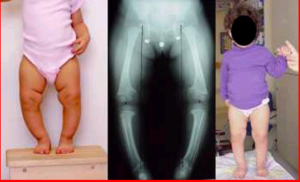
Rickets
It is the clinical manifestation of Vitamin D deficiency in children.
There is under mineralization of bones in children due to less absorption of calcium.
There is continued formation of the collagen matrix of bone, but incomplete mineralization, resulting in soft, pliable and bowing of bones.
Rickets (Children)
Osteomalacia
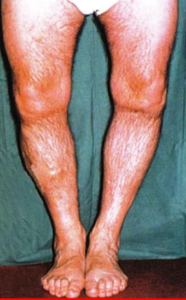
Osteomalacia is the clinical manifestation of Vitamin D deficiency in adults.
It results from demineralization of bone.
Picture shows bowed legs of a man with Vitamin D deficiency which results in malformation of the skeleton.
Osteomalacia (Adults)
Comparison between Rickets & Osteomalacia
Rickets
Rickets occurs in children due to Vitamin D deficiency.
There is insufficient mineralization of bones, soft pliable bones, bone growth markedly affected.
There is low plasma calcium & phosphorus.
Alkaline Phosphatase is markedly raised.
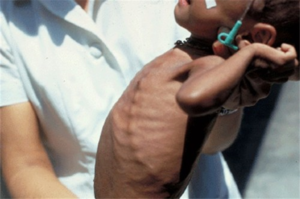
There are bone deformities like bow legs, knock-knees, rickety rosy, bossing of frontal bones & Pigeon chest.
Enlargement of epiphysis at the lower end of the ribs & costochondral junction leads to Rickety Rosary.
Harrison’s Sulcus is a transverse depression passing outwards from costal cartilage to axilla.
Osteomalacia
Osteomalacia occurs in adults due to Vitamin D deficiency.
Bones are softened due to insufficient mineralization & increased osteoporosis.
Serum Alkaline phosphatase is increased.
The serum calcium is slightly low along with low serum phosphate.
Vitamin D deficiency never produces severe hypocalcemia.
Tetany is not manifested.
Patients are more prone to fractures.
Rickets
Rickety Rosary
Harrison's Sulcus
Types of Rickets
Classical Rickets: Vitamin D deficiency rickets can be cured by giving Vitamin D in the diet.
The Hypophosphatemic rickets: mainly results from defective renal tubular absorption of phosphate. Supplementation of vitamin D with phosphate is found to be useful.
Vitamin D resistant rickets is found to be associated with Fanconi’s syndrome, renal tubular absorption of bicarbonate, phosphate, glucose & amino acids is deficient.
Renal rickets: Calcitriol (active Vitamin D) is not synthesized even in presence of Vitamin D. These cases may respond to calcitriol.
End organ refractoriness to 1,25-DHCC responds to mega doses of calcitriol 35 (mg/day).
Vitamin D & Metabolic Syndrome
Vitamin D insufficiency is associated with higher risk for metabolic syndrome.
Low serum Vitamin D3 is known to perturb cellular function in the endocrine pancreas, which is involved in the pathogenesis of obesity and Type II Diabetes.
Insufficiency of Vitamin D3 is common in patients with excess body weight & Metabolic Syndrome.
Vitamin D deficiency is associated with increased risks for hypertension, glucose intolerance, impaired synthesis & secretion of insulin, insulin resistance, Type II DM, metabolic syndrome, obesity, myocardial infarction, stroke, PVD, & asthma.
Vitamin D concentration positively correlates with HDL-cholesterol & negatively with serum triglyceride levels and LDL-cholesterol.
Vitamin D supplementation was found to be beneficial in all these clinical conditions.
The next topic will be "The Sources, Daily Requirement and Toxicity of Vitamin D"